Forex trading for beginners in 2026
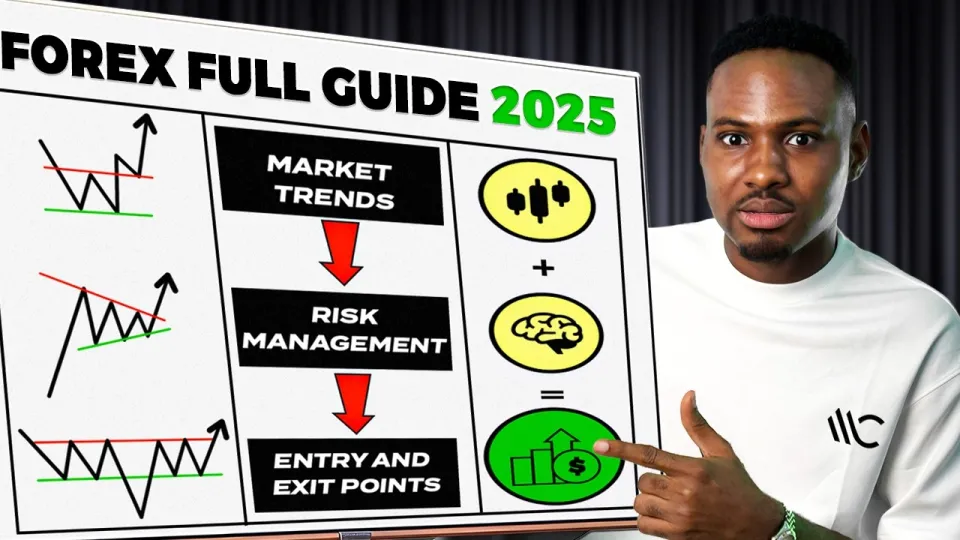
Video: How To Start Forex Trading For Beginners’ 2025 (Full Course)
You can order the same kind of articles for your own video to boost it on YouTube and Google. Just message the Telegram bot @sat_sit_bot. It writes articles around your video, embeds the video and publishes them on popular niche websites (no ads). Your first 50 articles are free.
· based on the channel Jeffrey Benson Forex
Key takeaways
- Forex is an over-the-counter market where currencies are quoted in pairs such as EUR/USD; there is no central exchange.
- Four sessions matter: Sydney, Tokyo, London and New York, with London–New York overlap carrying the heaviest volume.
- MT5 is the standard retail platform; a broker account, charting and a demo login come before any live trade.
- Risk of 1% or less per trade and a fixed stop-loss are the core of survival, not the entry signal.
- A single tested strategy on a demo account for several weeks beats collecting dozens of indicators.
Forex trading for beginners is best learned through one complete, ordered course rather than scattered clips: you need the market structure first, then a platform, then a single strategy, then position sizing, and only then a live trade. The full beginner course published by Jeffrey Benson Forex follows exactly that order, and students who want structured mentorship can see the paid options on the FirePipsFX plans page before committing any capital.
The logic is simple: most beginners lose money not because they pick the wrong direction but because they skip steps. They open a live account, copy a signal, size the trade at 20% of the balance and meet a margin call inside a week. A course that forces you through the boring parts — sessions, spreads, lot sizes, stop-losses — removes most of that failure mode before it costs anything.
What forex trading actually is and why beginners should start with the basics
Forex is the trading of one currency against another, quoted in pairs like EUR/USD, GBP/JPY or USD/ZAR, and it runs over the counter through a network of banks, brokers and liquidity providers rather than on a single exchange. That structure explains two things beginners notice immediately: the market is open 24 hours on weekdays, and there is no central tape, so your broker's price feed and spread are part of your trading conditions.
Prices move because currencies are relative. When the euro strengthens against the dollar, EUR/USD rises; the same news event can push one pair up and another down. Most retail volume concentrates in a handful of majors — EUR/USD, USD/JPY, GBP/USD and USD/CHF — because they have the tightest spreads and the deepest liquidity. Exotic pairs offer bigger swings but punish beginners with wide spreads and gaps.
Leverage is the feature that makes forex accessible and dangerous at the same time. A broker may offer 1:100 or more, meaning a $100 deposit controls $10,000 of currency. That magnifies both profit and loss; it does not increase your edge. Treat leverage as a tool for capital efficiency, not as a way to trade bigger than your account can survive.
How the market works across the four trading sessions
A forex day is divided into four sessions — Sydney, Tokyo, London and New York — and the pair you choose should match the session you can actually watch. Volatility and volume peak when London and New York overlap, which is the window most European and American beginners use; traders in Asia often prefer the Tokyo session and pairs such as USD/JPY or AUD/JPY.
Spread behaviour follows the same rhythm. During the rollover hour, when the trading day flips and swap is applied, spreads on many pairs widen sharply and stop orders get triggered by thin liquidity. Beginners who place trades at that moment often blame the broker for a "wrong" fill that was simply a normal liquidity gap.
Economic data drives the rest. Interest rate decisions from the Federal Reserve, the European Central Bank and the Bank of England, plus inflation prints and employment reports, move currencies more than any chart pattern. A beginner does not need to forecast these numbers; they need to know when they land so they are not holding an oversized position through a release.
The tools you need before placing a single trade
The minimum toolkit is a regulated broker account, MetaTrader 5 (MT5) or an equivalent platform, a demo login, and a notebook for your trade log. MT5 gives you candlestick charts, order types, stop-loss and take-profit fields, and a strategy tester for backtesting; a broker links your account to that platform with a server name, login and password.
A practical setup sequence looks like this:
- Choose a broker regulated by a recognised authority and check the spread and commission on EUR/USD during your intended session.
- Open a demo account first and fund it with the same amount you plan to risk live, so the numbers feel real.
- Install MT5, log in, and build one clean chart: a higher timeframe for direction and a lower timeframe for entries.
- Set the lot size so that a stop-loss at your planned distance equals 1% of the account.
- Record every demo trade — pair, session, reason, result — in the notebook.
The notebook is not decoration. Writing a setup down forces you to define entry, stop and target before the trade exists, which is exactly the discipline that separates a plan from a gamble.
Building a basic strategy foundation instead of collecting indicators
A beginner strategy needs three answers: which direction, where to enter, and where the idea is wrong. Trend-following on a higher timeframe plus a pullback entry on a lower one answers all three without any indicator beyond a moving average and a look at recent swing highs and lows.
A workable template: mark the trend on the four-hour chart, wait for price to return to a level it previously respected, enter in the direction of the trend, place the stop beyond the swing that would invalidate the idea, and target at least twice the stop distance. That 1:2 risk-to-reward ratio means you can be right less than half the time and still finish ahead.
Backtest the template on at least 50 historical setups before risking money. Count wins, losses, average win and average loss; if the maths does not work on paper, it will not work live. One tested strategy with a written rule set beats five half-understood systems, and it is the fastest route out of the loop of watching tutorials without progress.
Placing the first trade and sizing it correctly
Your first live trade should be small enough that losing it changes nothing about your week. Place a market order with a stop-loss and take-profit attached at the moment of entry, never afterwards, and size the position from the stop distance rather than from how confident you feel.
The formula: risk in money divided by stop distance in pips gives the value per pip, which converts into lot size. On a $1,000 account risking 1%, that is $10 of risk; a 20-pip stop means $0.50 per pip, roughly 0.05 standard lots on EUR/USD. This single calculation is what most beginners never learn, and it is the difference between a drawdown and a blown account.
Expect the first trades to feel uncomfortable. Slippage, spread and the temptation to move a stop-loss are part of the learning curve; the goal of the first month is not profit but a complete, rule-following trade log.
Common beginner mistakes and the questions they raise
Most beginner losses trace back to a short list of habits: risking too much per trade, trading without a stop-loss, revenge trading after a loss, switching strategies every week, and following signals without understanding the position size behind them. Copying trades is not inherently wrong, but copying a trade whose risk you cannot calculate is.
Another recurring theme is impatience. Beginners ask how long before they are profitable; the honest answer is that consistency comes from months of logged trades, not from a single good week. A demo phase of at least one to three months, with a stable equity curve and a written journal, is a reasonable gate before going live.
Finally, treat any course, signal group or mentorship as education, not as a guarantee. A teacher can shorten the learning curve and show a repeatable process, but the execution, the risk and the outcome stay with the trader.
Useful links
- FirePipsFX plans and student options — the author's paid mentorship and course tiers.
- https://t.me/firepipsignals — one free daily signal from the channel.
- https://my.assexmarkets.com/auth/register?partner_code=1699134 — the broker registration link referenced in the video.
- https://t.me/jeffreybenzhelpbot — entry point to the premium signal group.
Final word
Forex trading for beginners rewards sequence over speed: understand the pairs and sessions, set up MT5 on a demo, test one strategy with a defined risk-to-reward, size every position at 1% or less, and only then trade live. The full course from Jeffrey Benson Forex is a useful spine for that process because it moves in that exact order and spends real time on risk management rather than on shortcuts. Use the free material to build the habit, review the FirePipsFX plans page if you want structured guidance, and judge every result by your trade log rather than by a single lucky week.
Questions & answers
How much money do I need to start forex trading?
You can open a live account with a few hundred dollars, but the practical minimum depends on your risk rule. If you risk 1% per trade and your stop is 20 pips, a $500 account risks $5 per trade, which is workable on micro lots. Many beginners stay on a demo account until they have a stable, logged process.
How long does it take to become consistently profitable?
Realistically, months rather than weeks. A demo phase of one to three months with a written journal, followed by small live positions, is a common path. Consistency comes from repeating one tested strategy and controlling risk, not from finding a better indicator.
Is copying signals a good way to start?
Signals can be a learning aid if you understand the position size and the stop behind each trade. The risk is copying trades you cannot size or manage yourself, which turns a small loss into an account-ending one. Learn the maths first, then decide whether to follow anyone.
What is the biggest mistake beginners make?
Risking too much per trade and trading without a stop-loss. A trader risking 1% can be wrong many times and stay in the game, while one risking 20% needs only a few losses to be out. Position sizing matters more than the entry signal.
Source: How To Start Forex Trading For Beginners’ 2025 (Full Course) · Markdown version