Forex for beginners, a practical guide to starting trading
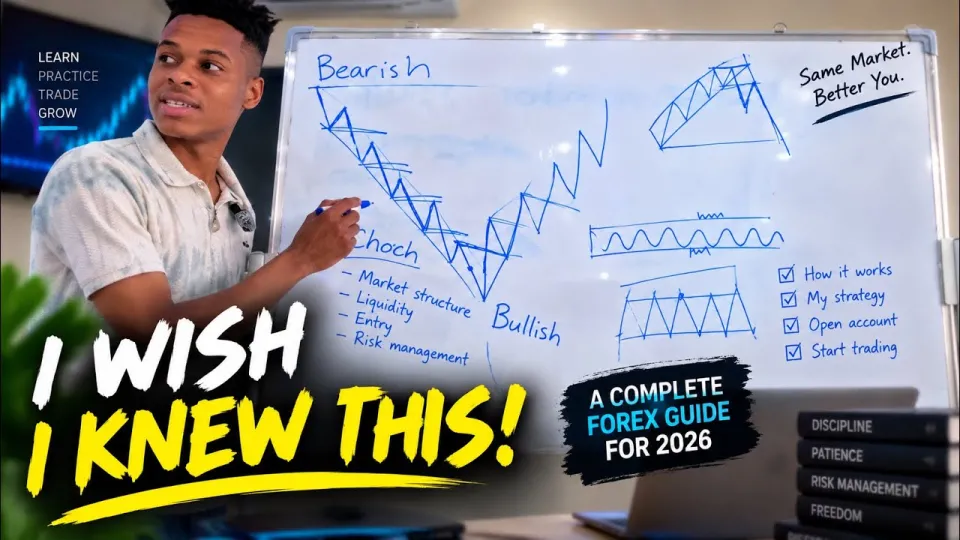
Video: How To Start Forex Trading For Beginners in 2026 (Full Guide + My Strategy)
You can order the same kind of articles for your own video to boost it on YouTube and Google. Just message the Telegram bot @sat_sit_bot. It writes articles around your video, embeds the video and publishes them on popular niche websites (no ads). Your first 50 articles are free.
· based on the channel Carl Fx
Key takeaways
- Forex is a decentralized market where currencies are traded in pairs; the most liquid pairs include EUR/USD and GBP/USD.
- Start with a demo account to practice without risking real money; most brokers offer unlimited demo time.
- Market structure (higher highs/lows for uptrends, lower highs/lows for downtrends) is the foundation of price action analysis.
- A simple strategy: trade with the trend, wait for a pullback to a key level, and enter after a confirmation candle.
- Risk management is crucial: never risk more than 1–2% of your account per trade and always use a stop-loss.
Forex trading for beginners starts with understanding that currencies are traded in pairs and that profits come from small price movements amplified by leverage — but so do losses. To begin, you need a regulated broker, a demo account for practice, a grasp of market structure, and a simple strategy with strict risk rules. This guide walks you through each step, drawing on insights from Carl Fx’s beginner tutorial and the questions real traders ask. You can open a practice or live account via TFC Global Markets registration to follow along.
What forex trading actually is and how it works
Forex is the global marketplace for exchanging national currencies, operating 24 hours a day, five days a week across major financial centers. Currencies are quoted in pairs — for example, EUR/USD — where the first currency is the base and the second is the quote. A price of 1.1000 means 1 euro buys 1.10 US dollars. Traders speculate on whether the base currency will strengthen or weaken against the quote currency.
The most traded pairs are EUR/USD, USD/JPY, GBP/USD, and USD/CHF; these have the tightest spreads and highest liquidity. Profits and losses are measured in pips — the fourth decimal place for most pairs (the second decimal for JPY pairs). Leverage lets you control a large position with a small deposit, but it magnifies both gains and losses. For instance, with 1:100 leverage, a $100 deposit can control a $10,000 position; a 1% move against you wipes out the entire deposit. That’s why risk management is non-negotiable.
How to open a trading account and get started from zero
Opening a forex account takes minutes, but choosing the right broker is the first real decision. Follow these steps:
- Choose a regulated broker. Check that the broker is overseen by a reputable authority (FCA, ASIC, CySEC, or similar) and offers segregated client funds. Carl Fx promotes his own brokerage, TFC Global Markets, in the video description; you can sign up here.
- Register and verify your identity. You’ll need an email, password, and typically a government-issued ID and proof of address.
- Open a demo account first. Practice with virtual money until you have a consistent strategy and understand the platform.
- Fund a live account only when ready. Start with a small amount you can afford to lose — many beginners begin with $100–$500.
- Download a trading platform like MetaTrader 4/5 or the broker’s proprietary app, and familiarize yourself with order types: market, limit, and stop-loss.
A common question from viewers is how to transition from demo to real money. The answer: trade on demo for at least one to three months, log every trade, and only go live after you’ve achieved a stable equity curve with controlled drawdowns.
Understanding market structure and price action
Market structure is the skeleton of price movement: it tells you whether buyers or sellers are in control. An uptrend consists of higher highs and higher lows; a downtrend shows lower highs and lower lows. When price breaks a previous swing high in an uptrend, the trend is confirmed; when it breaks a swing low, the trend may be reversing.
Price action is the study of raw price movement without indicators. Key concepts include support and resistance levels, trendlines, and candlestick patterns (engulfing, pin bars, inside bars). For example, a bullish engulfing candle at a support level in an uptrend often signals a buying opportunity. Carl Fx emphasizes that mastering structure and price action is more valuable than stacking indicators, because it teaches you to read the market’s story directly.
To practice, open a chart on a demo account, mark recent swing highs and lows, and label the trend. Do this on multiple timeframes — daily for the big picture, 1-hour or 15-minute for entries.
A simple trading strategy you can learn and practice
A straightforward strategy for beginners combines trend-following with a pullback entry. Here’s a step-by-step approach:
- Identify the trend on the daily chart: is price making higher highs and higher lows (uptrend) or lower highs and lower lows (downtrend)?
- Mark key levels — recent support/resistance zones and the 50-period moving average (optional).
- Wait for a pullback to the level or moving average in the direction of the trend.
- Look for a confirmation candle — a bullish reversal pattern (e.g., hammer, engulfing) in an uptrend, or a bearish one in a downtrend.
- Enter the trade and place a stop-loss just beyond the recent swing low (for longs) or swing high (for shorts).
- Set a take-profit at the next resistance (for longs) or support (for shorts), aiming for a risk-reward ratio of at least 1:2.
This strategy works on any timeframe but is easier to manage on the 1-hour or 4-hour charts. Backtest it on a demo account for at least 50 trades before risking real money. Remember: no strategy wins every time; consistency comes from execution and risk control.
Common mistakes traders should avoid
Most beginner losses stem from avoidable errors. The first is overleveraging — using too much leverage relative to account size. A good rule: risk no more than 1–2% of your account per trade. If you have $500, your maximum loss per trade should be $5–$10.
The second is trading without a stop-loss. A single trade without a stop can wipe out weeks of gains. Always define your exit before entering. The third is revenge trading — trying to win back losses immediately after a losing trade. Step away, review your plan, and only re-enter when the setup meets your criteria. The fourth is ignoring the news: major economic releases (NFP, CPI, central bank decisions) can cause violent spikes that trigger stops. Check the economic calendar daily.
Finally, many beginners underestimate the psychological aspect. Trading is a mental game; fear and greed lead to impulsive decisions. Keep a trading journal to track emotions alongside results.
Viewer questions and practical answers
Many viewers ask if they can start with a very small account. Yes — micro lots allow you to trade with as little as $10–$50, but keep expectations realistic: small accounts grow slowly, and the priority is learning, not earning.
Another common concern is the challenge of opening a real account. If you face verification issues, contact the broker’s support; ensure your documents are clear and match your registration details. Some regions have restrictions, so check local regulations.
A frequent request is for chart examples. While this article can’t show live charts, you can replicate the strategy on a demo platform: mark the trend, identify a pullback, and spot the confirmation candle. Practice on historical data using the platform’s bar replay feature.
Lastly, some viewers feel overwhelmed by the amount of information and doubt they can grasp it. The key is to focus on one concept at a time — start with market structure, then add a simple entry pattern, and practice until it becomes second nature. Consistency beats complexity.
Useful links
- Open a trading account with TFC Global Markets — the broker recommended by Carl Fx.
- Join Carl Fx’s free Telegram community — for discussions, trade ideas, and support.
Final thoughts
Forex trading is a skill that demands patience, discipline, and continuous learning. Start with a demo account, master market structure, apply a simple strategy with strict risk rules, and avoid the common pitfalls outlined above. The video by Carl Fx provides a solid foundation, and the Carl Fx channel continues to share practical insights for traders at all levels. When you’re ready to take the next step, you can register with TFC Global Markets to open your account. Remember: trading involves significant risk, and profits are never guaranteed — only trade with money you can afford to lose.
Questions & answers
How much money do I need to start forex trading?
You can start with as little as $10–$50 using a micro account, but it’s better to begin with a demo account and only go live when you have a tested strategy. Many brokers require a minimum deposit of $100–$200, though some accept less. Focus on learning first; small accounts grow slowly, so don’t expect quick riches.
Is forex trading risky for beginners?
Yes, forex is highly risky due to leverage and volatility. Most beginners lose money initially. To manage risk, never risk more than 1–2% of your account per trade, always use a stop-loss, and avoid trading during major news events until you have experience. Education and practice on a demo account are essential.
How long does it take to become consistently profitable?
It varies, but most successful traders take at least one to two years of consistent practice and study. Some may take longer. The key is to focus on the process: backtest your strategy, keep a trading journal, and gradually increase risk only after proving consistency on a demo account.
Can I trade forex with a small account and still make a profit?
Yes, but profits will be proportionally small. With a $100 account and 1% risk per trade, you’re risking $1 per trade — even a 1:2 risk-reward ratio yields only $2. The main goal with a small account should be skill development, not income. As your account grows and your strategy proves reliable, you can gradually increase position sizes.
Source: How To Start Forex Trading For Beginners in 2026 (Full Guide + My Strategy) · Markdown version